

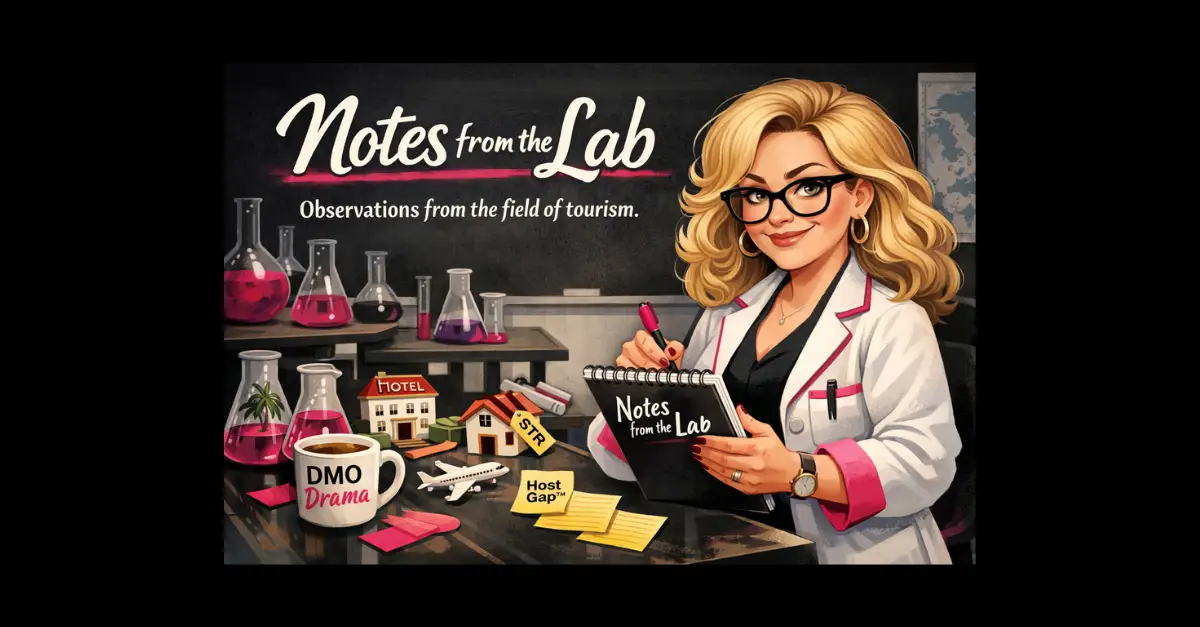
Notes from the LabField Entry – March 12, 2026
Dearest tourism observer,
The lab is open, the experiment is underway, and the sleep debt is real.
If you’re new here and wondering what exactly you just wandered into, let me catch you up.
We call it The Host Gap.
Quick context:
- STR bookings tipped $70B in 2025 (they passed hotels last September)
- In many destinations, a third of lodging demand now flows through STRs
- There’s no shared framework for how STRs and DMOs actually work together
- STRs often expect DMOs to promote their properties
- DMOs are stuck between residents, regulators, hotels, and a host community they can’t easily organize
- Both sides serve the same guest, but they’re rarely in the same room for strategy
So instead of building a shiny little widget to sell to everyone and their dog
(although I still believe in the untapped market of pupper clients)…
we’re trying something else.
We’re building an alignment engine.
Or said another way:
a human operating system for destinations and independent lodging.
Shared language. Shared roles. A way for everyone to stop guessing what the other side thinks they’re supposed to be doing.
It starts with the Hosts & Home Teams Living Lab.
Which means we’re basically trying to build an airplane while it’s already flying.
We’ll see how that goes.
Here’s what I’m seeing in the early weeks.
Destinations want to solve this.
But they’re cautious.
Questions come up fast:
- Is it okay to put hosts on the website?
- Who exactly are they?
- If we acknowledge them publicly will they expect promotion?
- Will the hotel flags lose their minds?
- What story are residents hearing about STRs right now?
Meanwhile, STR operators mostly skip right over the DMO layer.
- A lot of them genuinely don’t understand where the DMO fits into the tourism economy.
- And when they do reach out, the conversation often turns into…
an ad sales pitch.
- And when they do reach out, the conversation often turns into…
- A few STR leaders sit on tourism boards.
- Most do not.
Then there are the platforms.
They’re doing what platforms do.
- Adding tools.
- Stacking solutions.
- Promising that technology will smooth everything out.
But most of the problems I’m seeing right now are human alignment problems first.
Technology can’t fix that by itself, it never could.
Personally, I like messy systems.
Tourism moves fast, it’s political, and it’s full of personalities.
That’s where the interesting work usually lives.
Last week we helped Sonoma County assemble a cross-functional delegation for the Hosts & Home Teams Lab.
That accidentally revealed something important.
The summit actually works better when small delegations come together.
Not just the DMO.
A mix like:
- a destination leader
- a host representative
- someone from the policy or community side
People who normally argue about tourism actually working on it together.
Naturally, I’m rolling that out more broadly this week.
The goal is 50 delegations across the full spectrum of DMO ↔ STR alignment.
- The ones who’ve figured it out
(teach us, sensei). - The ones who’ve tried but are stuck.
- And the ones who are still in the “what the hell do we do with this?” phase.
Turns out my job right now is mostly curator.
The lab only works if we get the right mix of chemicals in the beakers.
A few early observations from the field:
STR operators resist self-identification.
Many see registration lists as a target list for enforcement.
Solve:
Give them something better than a hall monitor.
DMOs know the system isn’t solved.
But urgency is tricky.
New problems land on their desk every day:
weather events, international travel shifts, AI panic, someone yelling on Facebook.
Solve:
Alignment has to feel like it saves time, not adds work.
Platforms want closed loops.
Not because they’re villains.
Because fragmentation is profitable.
If you doubt that, try identifying every STR operating in your destination.
Watch how fast the invoices stack up.
Solve:
People problems get solved by people first.
Then the industry tells the vendors what to build.
That’s not radical.
Every mature industry eventually does it.
Tourism just hasn’t gotten there yet.
Three little tourism plot twists that landed on the lab desk this week.
While we’re building the Hosts & Home Teams experiment, a few signals from around the country landed on the lab desk this week. None of these are isolated stories. They’re reminders of the pressures shaping the DMO ↔ STR relationship everywhere.
 Observation #1 — Oregon, Tourism marketing dollars could shrink.
Oregon lawmakers just approved changes allowing cities and counties to redirect up to 50% of transient lodging tax (TOT) toward services like policing, roads, and infrastructure instead of tourism promotion. Helpful for communities under pressure… but potentially a squeeze for already stretched DMO marketing budgets.
(Google: Oregon lodging tax tourism funding bill)
Observation #2 — Arizona, The STR policy pendulum keeps swinging.
Arizona’s STR policy pendulum keeps swinging. Lawmakers are debating new tools to address problematic short-term rentals while backing away from broader restrictions on the industry. The balancing act between hosts, residents, and municipalities is still very much in motion.
(Google: Arizona short-term rental legislation 2026)
Observation #3 — Florida, The state vs. local STR battle continues.
Across Florida, cities and counties continue layering new registration rules, safety standards, and occupancy limits on top of the state STR licensing system. The result is a regulatory patchwork that operators and destinations are still trying to navigate.
(Google: Florida local short-term rental regulations 2025 2026)
What the lab sees:
Different states. Different headlines.
But underneath it all, the same underlying tension:
tourism economies are evolving faster than the systems designed to manage them.
Which is exactly the reason we’re trying to get everyone in the same room.
For now, the lab stays open.
The beakers are bubbling.
And the first delegations are starting to form.
Time for sustenance, more notes soon,
Jenn Barbee
Field Director